

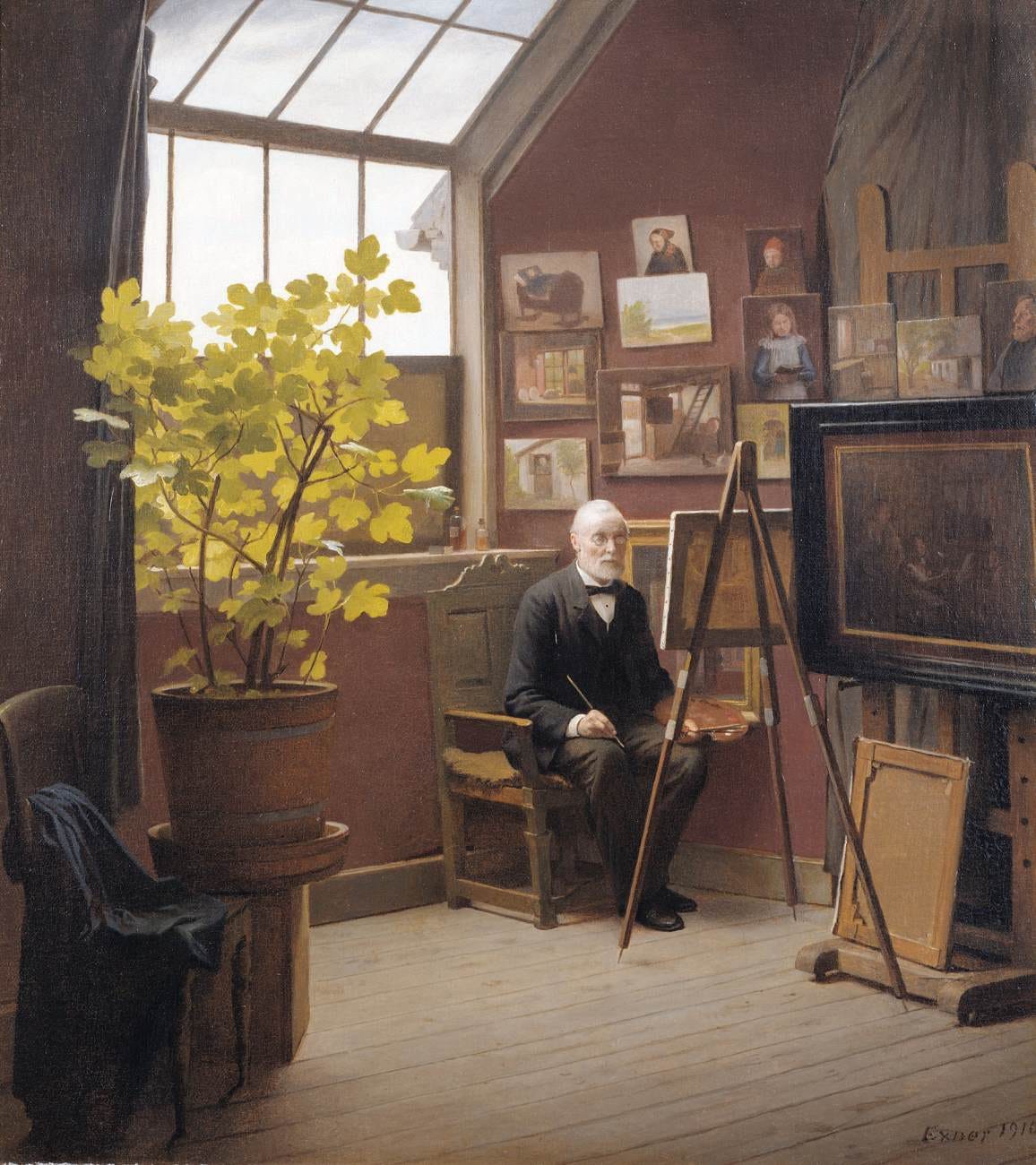
An artist in his studio, completing his last work of art. His gaze is towards the viewer, his life’s work decorates the walls.
Why the shroud on the chair in the corner? Why the canvas on the ground turned backwards? Why the bottles on the windowsill, or the colors on the palette, all red, white, and black?
John and I saw this painting at the Bruce Museum in Connecticut yesterday, and it entranced me. How clever, to paint yourself painting yourself—isn’t all the audience would see, regardless? Not Julius Exner the man, but Julius Exner the artist?
He is both important and not important, dressed to impress, but sitting calmly, not really trying to. He looks sort of sad, and he looks straight at you. He wants to connect with you. Yet, he is almost not even the focal point of this image. His work takes up more space than he does (and, strangely, a plant and a sunny window draw the eye most of all).
It struck me that this is the perfect visual depiction of how artists tend to connect with the world, and connect with themselves.
Writers, what do you think of when you think of ‘you’?
When I imagine my ‘identity,’ I see my work, not my face. When I envision my future, or my legacy, I envision books on shelves, not experiences and memories.
It struck me that this fascination might not be that healthy. There’s a certain distance one feels from the Exner when looking at this painting.
Contrast this with Rembrandt’s (many) self-portraits. Here’s one:
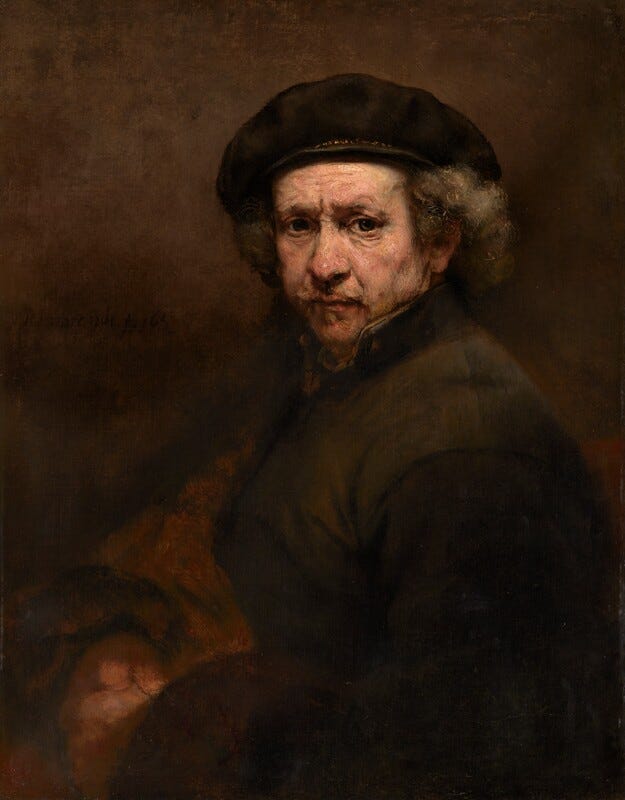
It’s more personal. More honest. I feel like I’ve met this man. Sure, it’s a Rembrandt, so this isn’t exactly fair (sorry, Exner, I stacked you against some stiff competition). But it’s worth examining the difference. Exner communicates with you through his background; Rembrandt speaks through the lines on his face. Exner looks towards you, but Rembrandt’s sad eyes look at you.
I’m not saying Exner’s is worse. In fact, his may have even impacted me more. However, the reason for this is that he didn’t so much paint a picture of himself as an idea of himself, which is staggeringly universal.
Is that the only version of himself that he feels comfortable putting on display?
Or is it the only version of himself that he knows?
Thank you for reading. If you enjoyed this post and would like to support my work, consider becoming a free or paid subscriber.
You can also buy me a coffee.
As a painter/artist I found this very interesting... To learn about the perspective of the one viewing my work. Sometimes the title of one of my paintings tells the entire story of the meaning in the painting. But giving a title can also limit the perspective of the one viewing it. I do personally love to hear what the viewer perceives.
Very observant and interesting Melissa!