

Table of Contents
Part I:
[ Chapter 1 ] | [ Chapter 2 ] | [ Chapter 3 ] | [ Chapter 4 ] | [ Chapter 5 ] | [Chapter 6] | [Chapter 7] | [Chapter 8] | [Chapter 9] | [Chapter 10] | [Chapter 11] | Chapter 12] | [Chapter 13] | [Chapter 14]
Part II:
[Chapter 15] | [Chapter 16] | [Chapter 17] | [Chapter 18] | [Chapter 19] | [Chapter 20] | [Chapter 21] | [Chapter 22] | [Chapter 23] | [Chapter 24] | [Chapter 25] | [Chapter 26] | [Chapter 27] | [Chapter 28] | [Chapter 29] | [Chapter 30]
29
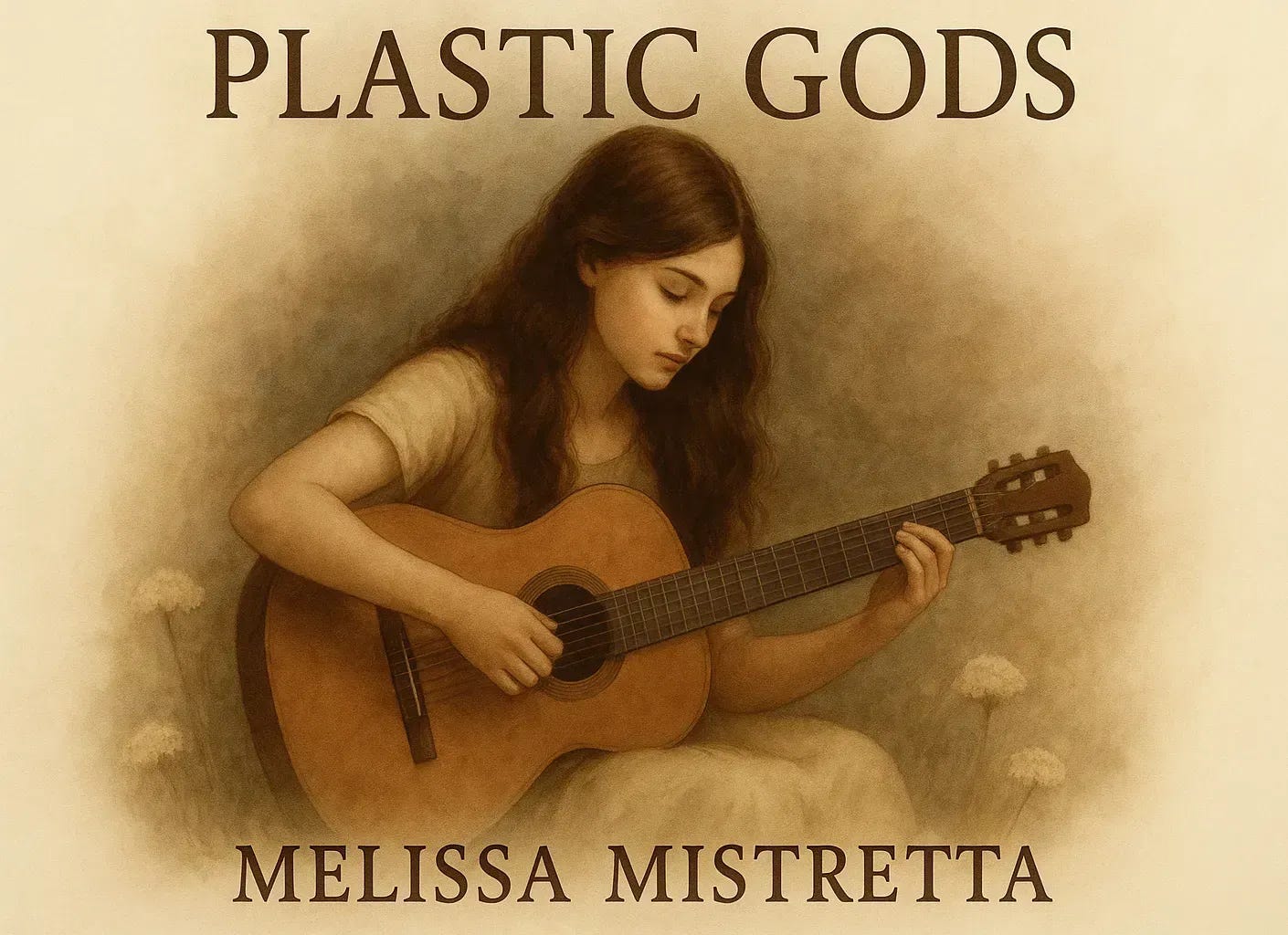
Plastic Gods
by Dahlia White
I attended my mother’s funeral last month. It was at a church, like most of these ceremonies are. My whole family was there, of course. Aunts, uncles, cousins, family friends, my own friends, people I didn’t recognize at all. Mom would have hated it. It got me thinking. Not about my mother, or how badly I’d miss her. Not about my own mortality (an ostensibly common thought at funerals), or my sister, or my poor, heartbroken father crying on the bench next to me. I thought about God, but not in the way that you’re supposed to think about ‘him’ in church.
Actually, my first thought was of my grandmother. Religion comforted her. She went to church every morning, prayed every night. I was embarrassed by this as a kid—she and her aging group of friends seemed like the last people in the world to actually buy into this dumb old story about angels and miracles and vengeful yet merciful gods counting your sins but excusing them as long as you go to church and confess and repent and believe.
Believe in what, exactly? The healing power of repetition—hearing the same stories over and over again for years, almost committing them to memory before some big authority decides to change them again? Was I supposed to think that feigning morality out of fear of divine retribution somehow made you a good person?
Grandma died when I was nineteen. She spent the last years of her life sick and struggling. I was absent for most of it. She had dementia; when I visited, it didn’t really feel like visiting her, anyway. In hindsight, I think seeing what her sickness did to her and the rest of the family was just too painful. Maybe this is just an excuse. When she died, it was almost a relief. I never properly said goodbye.
Who cares though, right? Nothing matters. At least that’s what I believed for a long time. She was out of her mind. What would me being there have mattered? But if nothing matters, then why has the guilt crept up on me, years later? Why do I keep thinking about the church she went to every day, hoping that what they preached was true, that she was in a good place, that I could be forgiven?
I felt like a hypocrite. I looked down on people that believed in this tradition, dismissed them as weak-minded for blinding themselves to the bleak realities of life and death with delusions of eternal life and some higher power. For some reason my mind always came back to death whenever I thought about this topic. I think we’re all terrified of our fate, whether we feign hardened indifference or not. Here I was, after touting all of this my entire life, looking to God when it was my turn to need him. More than this, it seemed like all the priests I loathed were right. If I had only listened to this dumb book I had been taught to believe in all those years ago, maybe I wouldn’t be in this situation.
When I began this project, I set out to write a paper in defense of the existence of a creator deity. To me, ‘God’ and ‘creator’ were synonymous, probably because I’d been taught to believe that they were by the very church that granted me my epiphany. I’d been thinking of the term ‘creator’ in the wrong way. I’d been imagining a being that waved a magic wand or played around with a chemistry set to create the universe. But really, if ‘God’ is a creator at all, it’s in the sense that ‘he’ is everything, and we, as small mortal creatures, are a fraction of everything.
Whenever a philosopher tries to argue for the existence of God, they usually default to the same few arguments. Atheists love to attack these arguments, and for good reason—they’re not the best ones out there. Take, for example, the argument that the universe is orderly, which proves some type of intelligent design. That the probability of such a world coming about based on pure chance is practically negligible, and therefore, it is more likely that someone or something deliberately designed it.
The problem with this argument isn’t that it’s necessarily false, but that it’s impossible to reconcile with the belief in an infinite universe. If the universe is infinite, then that means the ‘die is rolled’ an infinite amount of times, right? In an infinite universe, every possibility becomes an actuality, including one in which we exist. In other words, the ‘existence can’t be left up to pure chance’ argument is nonsense.
The ‘moral argument’ is a bit better—it’s the idea that God must exist because the human conscience exists, and God must be the originator of this conscience.
This argument could be attacked, too. For one, customs vary between cultures. Can it be said with absolute certainty that there is a ‘universal’ human moral code? Well, maybe. But even so, who’s to say that God’s to blame? We all behave the same way because we’re all part of the same species. Humans collaborate because we’re wired to, just like wolves are wired to hunt and sheep are wired to follow the herd.
What both of these arguments have in common is that they center around the idea of intelligent design—an idea that is not completely synonymous with the existence of God. I don’t think there’s any way to really prove how we were created, nor does it really matter. The fact is we’re here, and that there are spiritual forces around us that we can perceive, if we look for them. These are the forces we may call ‘God.’
There’s the phenomenon of ‘synchronicity’: occurrences that don’t appear to have any causal link, but are too perfectly aligned to be pure coincidence. Thinking of someone you haven’t thought of in years, and then later that day, running into them on the street. Seeing repeated numbers, or a name popping up over and over again. These kinds of things suggest a connectedness of all things—an indication that there is more to life than what meets the eye. Then there’s manifestation, “thinking things into existence.” Perhaps you’re visiting a friend’s house outside of the city, and you’re terrified of spiders. For some reason, you have to go into their basement. You just know a spider is going to appear, and sure enough, you see a huge one. You tell your friend, who says she’s never seen a spider in the house. Did thinking of the spider make it appear?
Conjuring success (or failure) is real, and it may be the most compelling argument for existence of God that there is. I like to call it the ‘utility argument,’ and it goes like this: God exists because it is more practical to believe in God than not to.
The most prolific artists in the world point to a higher power as the source of their work. Authors, painters, musicians—it’s the same for everyone. Even if they do not call this force ‘God,’ they are aware they are tapping into something that is external to themselves, something they cannot explain. And if they aren’t—if they think that this creative force lies within them and them alone—then their work is inconsistent and painful. Perhaps they’re prone to addiction or depression. Perhaps they burn themselves out and die young—spiritually or physically. The ones who believe in God generally don’t. There are exceptions to this, of course. But this is the tendency.
Perhaps it is for this reason that scripture is often called ’the inspired word of God.’ It comes from that place that writers tap into that they can’t really understand. This is why the best stories are like mirrors. They tell us truths about the world, and about ourselves, in ways we cannot articulate.
God does not only reveal himself in art—we can see him everywhere. Spirituality is a guidebook for life. Following the principles contained within the myths that have served humanity for thousands of years makes you kind, altruistic, and good. The people who consider themselves spiritual are happier.
God was what guided my grandmother through her life. She and her friends would go to this little store downtown that sold lots of religious stuff like jewelry and statues and paintings. Her favorite things to buy were these little miniature figurines, replicas of holy people and holy objects. She couldn’t afford the expensive ceramic figurines, so the ones she bought were plastic.
She’d put them all over the house—on the windowsill, on her bedside table. She held them in her hands whenever she prayed. Whenever I stayed at her house overnight, we prayed together before bed. Before we started praying, she always handed me two of these little plastic gods, one for each hand, and pressed my fingers down around them to make sure I was holding them tight.
My grandmother lived a good life. A long life. She was well-loved, and she died knowing that she had lived the best she could. Though she suffered leading up to them, on her last days, she was peaceful and content. She didn’t fight nature; she accepted it.
Obviously my grandmother’s conception of God isn’t the only one out there. Nor would I consider it the best one. Nevertheless, she embodied the human compulsion to believe in something, and was the better for it. A spiritual life is a happy life. Compare this with the young people today walking around with no purpose, blaming the world for their problems, seeking psychological diagnoses and medicinal relief. They worship, too, although they don’t like to believe it. They worship scientists, products, themselves. Judging by simple efficacy, these are lesser deities.
Sure, this doesn’t really prove anything. There are counterarguments to all these things. “Confirmation bias” is a big one. We’re more likely to notice synchronous events, for example, if we are looking out for them. Just because an idea is helpful (and tempting), that does not necessarily mean it is true.
Nevertheless, mythologies have popped up in every known civilization to explain the unexplainable. The human ‘will to believe’ is so strong, it makes itself known everywhere. Sure, there’s no irrevocable proof of God. If we think abstractly enough, we reach a certain point where nothing can be proven at all.
All we have are theories. And, if compelled to make a theory, shouldn’t we choose the one with more evidence weighed in its favor? “God exists” and “God does not exist” are two equally unfalsifiable claims, and more evidence points to his existence than his nonexistence.
Furthermore, when conceptualized this way, whether or not you believe in ‘God’ has little to do with whether or not you believe in magic, and everything to do with how you define your terms. It’s hard to argue against the idea that everything came from somewhere. If ‘God’ is used to describe ‘the entire universe as a collective,’ whatever that means, then there’s no way to argue against its existence—it just is. I’ve used the word ‘he’ throughout this essay, but obviously, God isn’t male, nor is ‘he’ a person at all.
In essence, it’s an endless loop. An impossible question. The purpose of this paper is to pick a side and argue it, but the idea of ‘god’ is so shifty that it defies all definition. The idea is bigger than us. It is beyond language, beyond comprehension.
Does that mean that it does not deserve study? If we restrict ourselves to only examining topics that fit into nice, neat boxes, are we really fulfilling the purpose of philosophical inquisition? There are questions that cannot be proven empirically. Regardless, the answers exist.
I’ve never seen something come from nothing. My life experience suggests the existence of God.
Spiritual people lead happy, productive, and meaningful lives. Their life experience suggests the existence of God.
Every culture that has ever existed has created a mythology. Our technologically sophisticated, hubristic modern society is the only one in history to worship ourselves. We are the outliers. The collective human experience suggests the existence of God.
Where reason and empiricism fails, perhaps instinct is the arbiter of truth. Our ancestors relied on intuition. Our safe, structured lives have rendered our senses rusty.
Wisdom is knowing what you do not know. This is not our area of expertise. The modern world simply isn’t equipped to answer the ‘God question.’ Perhaps it is okay, in this case, to defer to the experts.
Wherever intuition has reigned, so has God.
30 - Chasing the Dragon
The next day, embracing his new self-imposed state of semi-retirement, Aios kicked his feet up on his desk and started reading a book. It was titled Chasing the Dragon, and on its cover was an image of a snake eating its own tail. Aios saw it sticking out of Dahlia’s bag as she left his office. It caught his eye because he had a copy in his home library.
Dahlia was happy about her grade, and was even happier about the comment she received: “Excellent work! Authentic, inspiring, and, profoundly unscientific. I will be following your career in the future.” Aios wrote the comment in earnest, but silently hoped for the girl’s sake that she would not pursue a career in academia.
As Aios lounged, Theo Voss and three other department heads sat in Maxim Gates’ office on the other side of the university, filling out paperwork requesting approval for the electrical power and materials necessary to build a miniature planet. The project was labeled an ‘interdisciplinary study,’ combining biology, astrophysics, computer science, and, of course, philosophy. Naturally, it was highly classified.
Meanwhile, inside the Microcosm, it had been two years since Mona’s death. Soma had broken up. The members couldn’t bring themselves to play together after what had happened.
Soma’s popularity exploded after Mona’s death, but then it slowly waned. Other, newer bands had emerged—bands that were willing to tour and release new albums.
Meanwhile, Hymns, Requiem, Bread & Butter, and Mona were growing in popularity in Aios’s world. Music like that had been extinct for so long that its resurgence was like a type of revolution. Listeners loved Mona most of all.
Simon found another band. Craig lived happily with the love of his life. Ben—well, no one really knew what happened to Ben.
Nathan still lived in the house he and Mona shared. He made music sometimes, but never released it. He didn’t feel the need to. He had made his money, experienced his fame, and didn’t really like the way the spotlight felt, anyway. He toyed with the idea of playing live again in the future, but for now, it was too much for him to think about.
For now, he was content living in the shadow of Mona’s legacy, listening to the music they once shared, and releasing spiders outside the bathroom window, just in case she was watching.
The End.
Well, it’s over.
This was a strange experience for me. I wrote this book a long time ago, and while it’s certainly written by ‘me,’ it’s a 'version of me that doesn’t really exist anymore. Reading it over again, it was almost like experiencing the story for the first time.
To everyone who made it to the end: thank you. I’m honored that you stuck with this story until the end, and I hope that you enjoyed it. Your feedback and support has kept me going.
I’m so proud of you for getting this novel out there. I can honestly say that it’s one of the best books I ever read, and I’m not just saying that. Can’t wait to see how your novels develop in the future!
Well Done Melissa, so honest - Thank you!
I especially appreciate your writings:
Wherever intuition has reigned, so has God.
This was a strange experience for me. I wrote this book a long time ago, and while it’s certainly written by ‘me,’ it’s a 'version of me that doesn’t really exist anymore. Reading it over again, it was almost like experiencing the story for the first time.